Knowing Your Values Isn't Enough
You know your values. So why does your life keep reflecting something else?
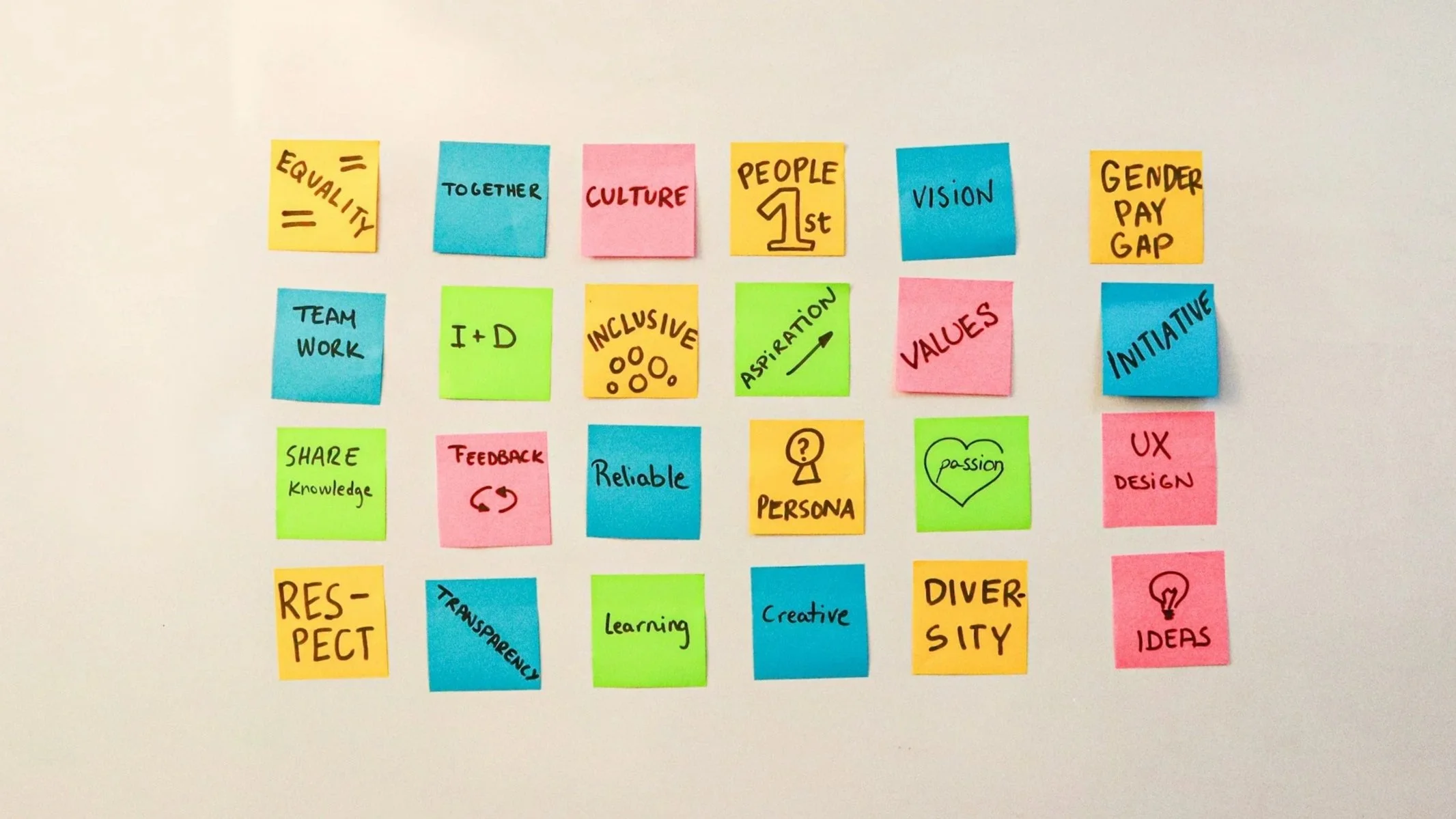
Don’t let this be the place where your values go to die.
Most conversations about values start the same way: someone hands you a list of words, tells you to circle the ones that resonate, and calls it done.
I understand the appeal. It's tidy. It feels like progress. But here's what I've found after years of doing this work: choosing a value from a list and actually living by that value are two very different things.
And there's a reason for that.
K N O W T H E D I F F E R E N C E
The Values You Say Out Loud, and the Values Quietly Running the Show
We all have two kinds of values operating in our life at any given moment.
The first kind are the ones you'd say if someone asked. “I believe in integrity! Family! Growth!” They live on vision boards and in journal entries. You believe in them. And they're real.
The second kind are the ones you've never said out loud, but they're woven into nearly every decision you make. Things like: Don't make things difficult for others. Keep the peace. Be the capable one. Don't want too much.
Those aren't values you chose. They're values you inherited by your upbringing, your culture, and the survival patterns that got you where you are. And when left unchecked, they start quietly pulling your life in a direction you didn't consciously choose.
“When your stated values and your operating values are misaligned, you feel it, even if you can’t name it. It shows up as that low-grade restlessness. The sense that something is off, even when nothing is technically wrong.”
This is your inner compass telling you that it’s time to slow down. That it’s time to do a values audit and reset. Because when we stop choosing our values, other people will choose them for us. (Just like that notification that keeps calling your name…)
So what does it actually mean to “know your values”?
It doesn't mean reciting a list from memory. It means being able to answer, honestly, the question: what am I actually prioritizing nowadays?
When you say yes to something you resent, what value is driving that yes? When you feel a flicker of excitement about an opportunity, what does that excitement point to? When you stay too long in something that isn't working, what belief is keeping you there?
Naming your values is an act of self-honesty. You're surfacing something that's already been shaping your life. Now, you're getting to see it clearly. And once you can see it clearly? Things will start to shift, and life stops feeling like a trap you need to escape.
T H E B E N E F I T
When You Know Your Values, Life Gets Simplier.
It feels quieter because the constant doubts starts to fall away.
Decisions that used to cause you to spiral now feel simpler. Not because your options have changed, but because you have a personal compass to make sense of the options in front of you. You stop asking, "what should I do?" and start asking, "what is true for me?"
Your decisions become easier to hold because they stop feeling like you're saying no to someone else and start feeling like you're saying yes to yourself. You stop outsourcing your sense of direction to everyone else, and you start trusting that your gut is giving you real information.
That's the practical power of values. It's not a personality test or a branding exercise. It's a personal navigation system.

Making decisions can be overwhelming, even for those of us who do it professionally.
30 Values Worth Sitting With
Here’s an invitation: read through these slowly. Notice what lands, what made you roll your eyes, what made you hold your breath—and why. The values that create a reaction are usually worth exploring further.
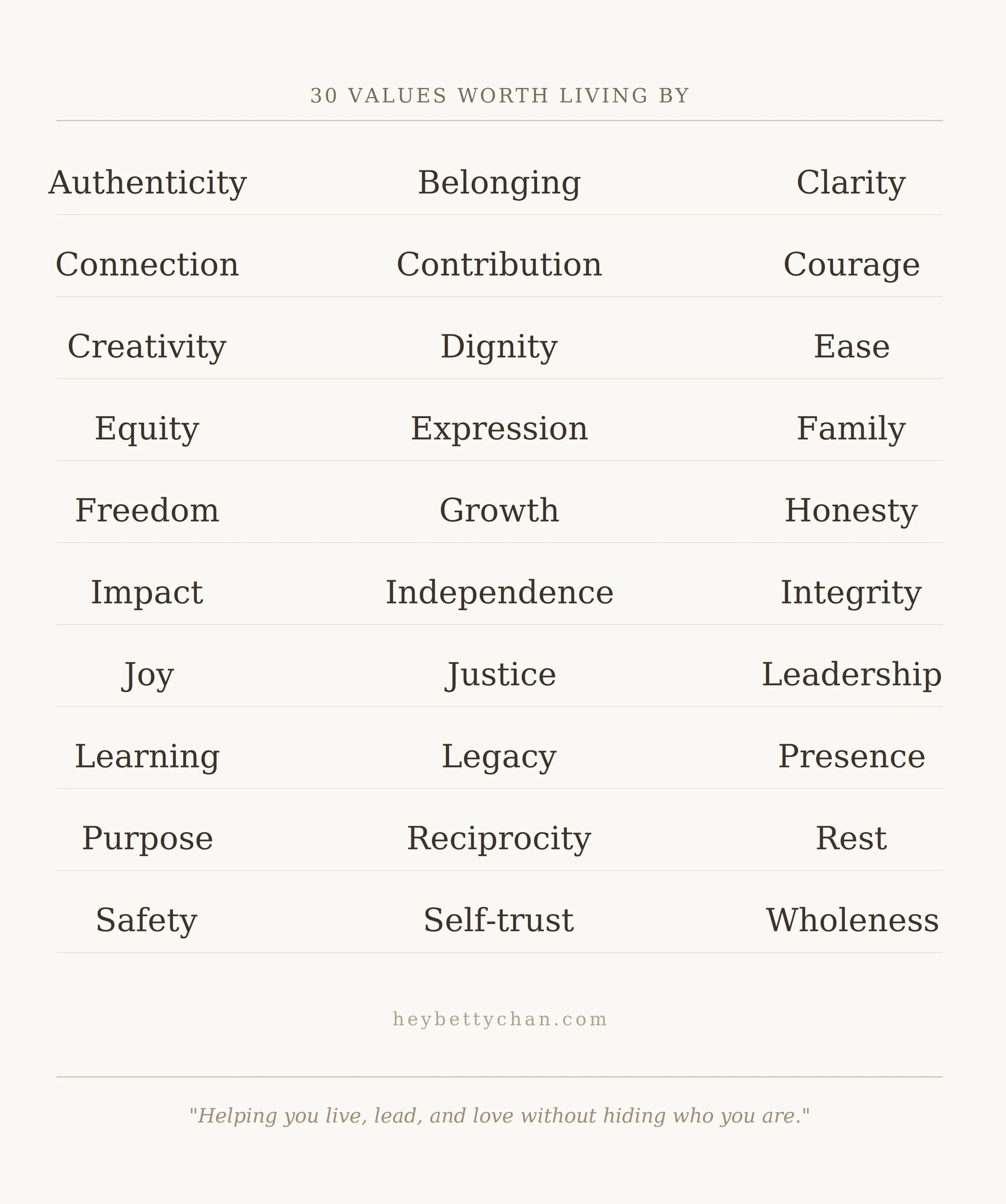
A collection of common values my coaching clients now use to guide their everyday choices.
Authenticity Living and showing up as the full version of yourself, not a curated or edited one. This one hits for people who've spent years performing for their environments.
Belonging Not just being in the room, but feeling like the room is welcoming. This is about being received, not just tolerated.
Clarity Knowing where you stand and what you're working toward. People who crave clarity often grew up in environments where things were unpredictable or undefined.
Connection Relationships that have real depth, not just surface-level pleasantness. This value gets quietly violated every time you mask or minimize yourself with people who matter to you.
Contribution Feeling like your efforts makes a genuine difference. Not just the big, award-winning moments, but the everyday commitments.
Courage The willingness to move toward things that scare you, rather than only toward what feels safe. Often shows up as the thing you admire most in others.
Creativity The freedom to make, express, and imagine. For high achievers in structured environments, this one gets suppressed early and mourned quietly for years.
Dignity Being treated (and treating yourself) as someone whose experience and presence inherently matters. This is often where resentment lives when you’ve been passed over or forgotten for a long time.
Ease The felt sense that life doesn't have to be a constant grind to be worth something. Radical for anyone who was raised on the idea that struggle or hard work comes before enjoyment and rest.
Equity A deep investment in fairness within systems, relationships, and structures that don't require some people to give more just to be taken seriously.
Expression Having outlets for what's inside you, whether that's through words, creativity, fashion, etc.. When this is missing, people often feel vaguely suffocated.
Family Deep ties and commitment to the people who form your core, however you define family. Worth examining whether this value is a true north or an obligation you haven't questioned yet.
Freedom The ability to make choices that are genuinely yours. Especially potent for anyone who has spent years optimizing for someone else's vision of their life.
Growth Staying in motion intellectually, emotionally, personally. The itch when you feel like you're stagnating. Watch for when this becomes a way to avoid stillness or rest.
Honesty The commitment to say true things even when they're inconvenient. This one is often undervalued until its absence poisons something important.
Impact Wanting your work and presence to leave something behind. Different from legacy; impact is often more immediate and changes the urgency of your decisions.
Independence The ability to act from your own judgment, not because someone else approved it first. Strong in people who feel most alive when they're self-directing.
Integrity Alignment between what you think, say, and do. When this is not able to happen, you may feel an internal dissonance that doesn't go away until something changes.
Joy Not happiness as a mood, but the genuine lightness that comes from being in your life rather than managing it. Often the first thing sacrificed and the last thing reclaimed.
Justice A conviction that things should be right, not just functional. Often paired with a deep sensitivity to what's fair for ourselves and others.
Leadership Influencing direction and creating conditions for others to thrive. Notice if this one shows up as something you step into naturally or something you've been assigned and are still deciding whether it fits.
Learning Staying curious. The belief that understanding more is inherently worthwhile. This one sometimes shows up as a yearning to have more time to explore.
Legacy What you want to leave behind in your work, your relationships, your life. Often surfaces when we move into a new decade of life and you start asking bigger questions.
Presence The ability to actually be where you are: not planning for the future or ruminating about the past. Often what people mean when they say they want to slow down.
Purpose The sense that your life and work are pointed at something that matters to you. This is the one people describe feeling when they say things finally feel like theirs.
Reciprocity Relationships and exchanges where energy flows in both directions. Its absence is often what creates quiet resentment in people who give a lot and receive little.
Rest Not just sleep, but permission to stop. Revolutionary for anyone who learned early that value is earned through productivity.
Safety The ability to be yourself in a space without bracing for the consequences. Deeply underrated as a value until you've lived for a long time without it.
Self-trust Acting from your own inner knowing, even without external validation. For many adults, this is the value they are actively working to rebuild.
Wholeness The integration of all parts of yourself, not just the parts that are easy to understand or accept. This is the one that usually sits underneath all the others.
D O N ’ T F O R G E T
Picking Values isn’t the Destination
Most values exercises stop here: at the list. You identify your top five. Maybe you even feel genuinely moved by them in the moment, but when life resumes, nothing actually changes.
That's because naming a value is just the first step of a much longer process: the process of integration. Learning to recognize when a value is being honored and when it's being violated. Noticing which decisions cost you something and which ones fill you back up.
Integration is a collection of small, unglamorous moments.
The day you chose to get off work on time.
The conversation you stop avoiding.
The opportunity you let go of because it looks good on paper but feels wrong in your body.
Over time, those moments compound. That's how a value stops being a word on a list and starts becoming a part of how you actually move through the world.
What to Do With Your Values
Read back on the values that stopped you in your tracks, even if only for a moment. Ask yourself:
“Is this a value I’m already honoring or one I’ve been quietly starving?”
Closing the gap between what you know matters to you and what your life is filled with (or empty of) is the work of creating an authentic life.
You don’t need to overhaul everything. The more clearly you can see your own values, the less you have to guess at why something feels off. And the more confidently you will feel as you start making choices that reflect who you truly are.
Rooting for you,
Betty
If you’re done guessing your way through life…
let’s ground your big and small choices in the values that make life worthwhile.
Schedule a free discovery call to learn about my coaching, or shoot me a message on Instagram.